
Limbo, Crash and Dice: Three Games With the Same Math
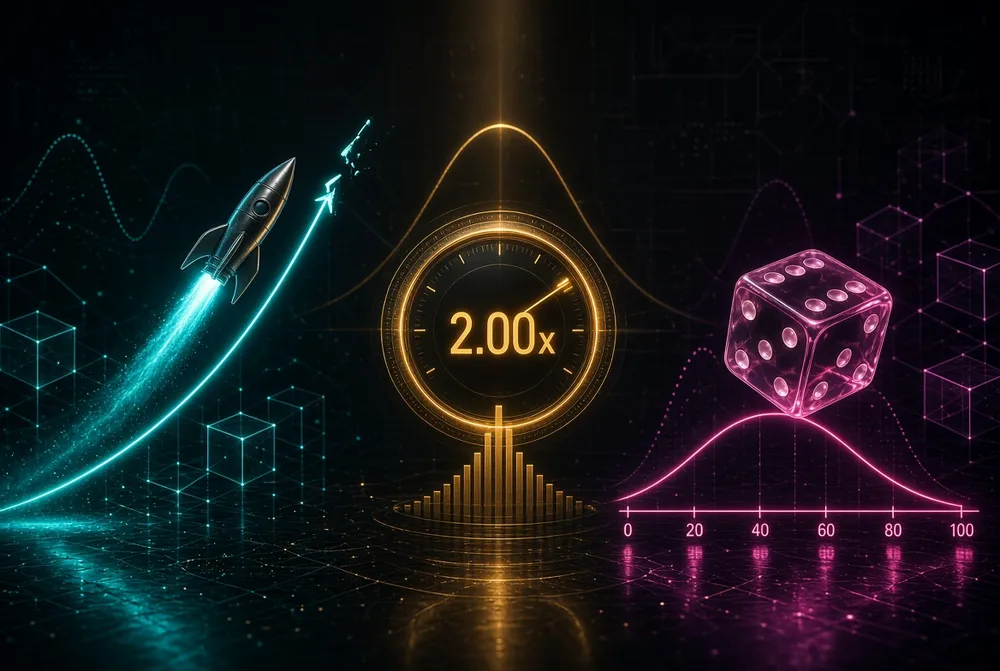
Remember life before Limbo, Crash and Dice? (And yes, Plinko and Mines, which all sit in the same sort of family.) Us neither.
They’re part of the reason we love playing at crypto casinos because these games are fun, easy and - shhhh - a little bit addictive. And when we’re killing time on that daily commute or putting off the dishes, nothing beats a few minutes of holding our nerve in the hope of winning a few dollars!
Yes, they all look a little different on the surface, especially with their different designs and premises. One has you watching a climbing rocket, one simply wants you to guess a multiplier, and the other has you channeling your luck to bet on a dice roll outcome.
But underneath, they’re actually surprisingly similar because they have the same maths model. Each is working with a random number, then applying the RTP, or house edge, and then flagging up whether it's a win or a loss bet.
Weird thought too - the game’s outcomes are all predicted in advance, and because they’re crypto games, you can verify their fairness on the blockchain using special software.
So…. have we got the same chance of bagging a win across each game? Nooo. We’re here to explain why.
What to know about Limbo
Limbo’s one of the simplest crypto native games there is. Just pick a stake and your target multiplier, then place a bet. The game uses its random number generator to give you a figure, and if the multiplier meets or beats your target, you win. Simple.
With figures - you might bet $10, set a target multiplier at 2x, then if the game throws up 2x or more, you get $10 + your original $10 stake. If it comes up at under 2x, you lose your $10.
The simplicity is intriguing. The higher your target, the more you might win, but the less likely you are to. Most Limbo games are built with Random Number Generator (RNG) software and provably fair gaming systems, so you can verify the results after play.
But it’s your choice of multiplier that determines how likely you are to win, not how well you predict the next result. Hold that thought.
Crash: Same premise, different format
Crash takes Limbo and adds a little spice by using a multiplier that grows out of time. You’re there to cash out before crashes, and if you do, your chosen multiplier applies to your stake.
So, you wagered $10, set a 2x cash out, and the game reached that, so you got $20. If it crashed at 1.7x, you’d lose your $10 and have nothing. Similar to Limbo, right?
With both games, you win if the RGN software hits your chosen multiplier. With Crash, you watch the multiplier climb and hold your nerve so it gives the sense that you’re somehow involved in influencing the outcome, even though the trigger for the crash has already been determined. It doesn’t matter if you watch or not; that’s just casino psychology keeping you engaged!
Dice: Same maths, no multiplier
Dice looks different as it’s showing a number from 0 to 100. You pick whether you think the result will land above or below a threshold, and the game generates the same RNG to see if you were correct.
So you might pick a roll under 49.5, so you’ve got a 49.5 chance of winning, on a Dice game with a 1% house edge. The payout multiplier becomes a 99% return to you, divided by your win probability of 49.5%.
The theoretical win and payout are the same as a Crash or Limbo bet at 2x, so long as all games have a 1% house edge.
What the maths is doing
If you’re interested in how this all works, you can see how the math works in action. So let’s look at extreme cases:
- With a target multiplier of 1.5x, you have a 66% chance of winning a $5 profit on a $10 wager
- At 2x the chance of winning is 49.5%, and you’d win $10 profit (& your $10 stake)
- Go up to 10x, and you’re looking at a 9.9% probability but a $90 win
- And at 100x, your win probability is only 0.99%, but your profit is $990.
The key thing is that when Limbo, Dice and Crash use equivalent maths models, the figures above apply to all three games (though just bear in mind that online crypto casinos tend to apply their own rules and methods to adjust things slightly in practice)
Also, we have to remember that maths models show long-term trends from huge and theoretical groups of players. Your own individual game experience while you’re pretending to listen in that long and boring work presentation might be completely different. And yes, we hope you win big too.
What effect do provably fair RNGs have?
Most good crypto casinos are using provably fair technology so that players can verify results after they’ve played. Widely available software (usually available via the online crypto casino itself) shows that the results were fair and verifiable. However, they don’t show that the game has a ‘good’ house edge for players or that all casinos are using the same formulas.
So does it matter which game you play?
If we see Limbo, Crash and Dice all being offered with a 1% house edge, the theoretical returns are the same. But the experience itself has a different effect on how you bet because of the psychology behind each game.
For example, if you love quick round play, you’ll love Limbo for the instant outcome reveal. If you love simplicity and quick options, you might prefer Dice, and if you go for the adrenaline rush of delayed gratification (or plummeting regret), then you might go for Crash.
But it’s interesting to know that the house edge remains consistent, and the link between risk and reward also stays in place between each game.
So, for you as a gamer, the ‘best’ approach is to simply choose the game you really love to play, and do so at a crypto casino with the best possible sign-up and promos, player terms and all-around quality offer to max your experience and outcomes!
Test here Free Crypto Casino Games Demos
Above all, focus on fun and entertainment rather than ‘rules’ around the best game. We’re here to enjoy ourselves, not to create another job!


