
If Your Tournament Moved Continents With 30 Days' Notice Could Your Logistics Survive It?
Marcel Meyer, Global VP Global VP Esports and Live Events, ICAT
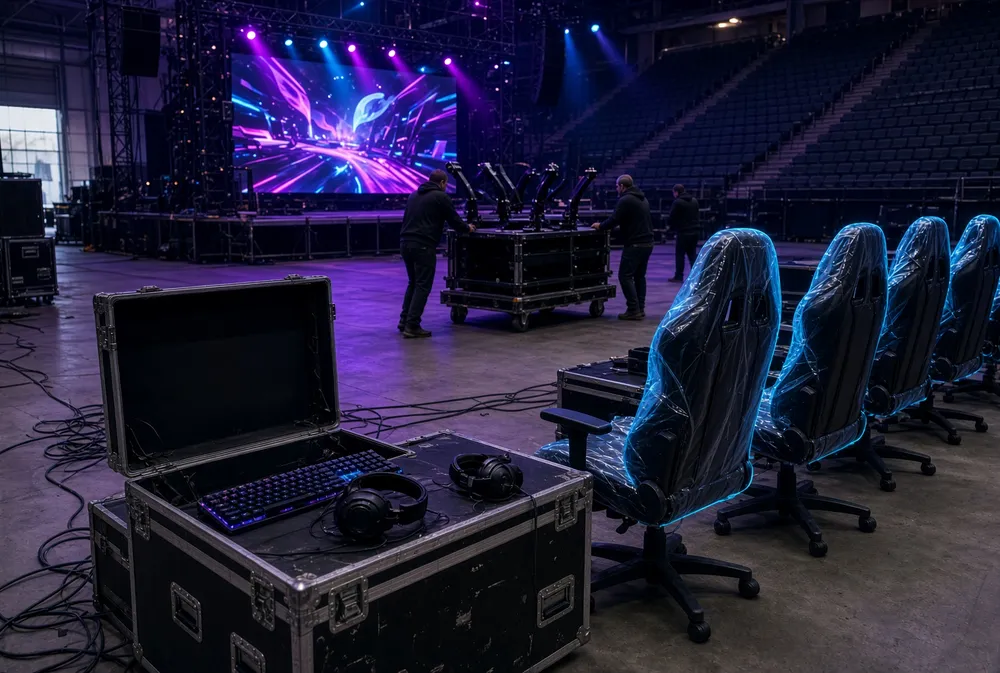
In May, the Esports World Cup moved from Riyadh to Paris. Doors opened in roughly 30 days. Everything the tournament needed sat in a warehouse in Saudi Arabia: gaming chairs, laptops, server infrastructure, staging, the full production. All of it had to be in Paris, on time, ready for a live global broadcast.
It got there. A 747 charter. An Airbus A300 charter. Commercial freight. Fifteen to twenty trucks rolling in from Poland. Every piece landed before load-in.
I run event freight for a living, and I will tell you plainly: most logistics arrangements in Esports would not have survived that month. So ask yourself the question I ask every operator I meet. If your event moved continents tomorrow, could your freight partner deliver?
The industry outgrew its shipping habits
Esports is no longer a niche. Global audiences now exceed 640 million. Industry revenue is climbing past $5 billion. The World Cup in Paris carries a $75 million prize pool, the largest in competitive gaming history. Flagship events fill arenas and broadcast live to more than 40 territories at once.
Yet many Esports organizations still buy logistics the way they would ship parcels. They sign general freight contracts built for cost per kilo and flexible delivery windows. That model works fine for warehouse replenishment. It fails at an arena door.
Here is the difference. When a pallet arrives a day late at a distribution center, you pay a fee and move on. When a server rack arrives a day late at a venue, you lose rehearsal, technical testing, and possibly the broadcast itself. General freight arrives when it arrives. A live show cannot.
The industry is young, and much of it has not yet learned to run on hard deadlines. That gap, not viewership or sponsorship, is now the biggest operational risk in Esports.
You are not a gaming company with a shipping problem
Here is the reframe I push in every conversation with tournament operators and league executives: Esports is not a gaming industry that happens to move equipment. It is a live entertainment industry that has not yet started operating like one.
Music touring learned this decades ago. So did festivals, theatre, and professional sports. In those worlds, freight is production, not procurement. The people moving the cargo sit inside the show schedule, not outside it.
The Paris relocation proves the point, because the hard part was never the airplanes. It was judgment. Clearing customs in Paris would have been slow and unpredictable, so we flew everything into Maastricht instead, cleared it in the Netherlands where we control the process, and trucked it to Paris. That cost slightly more. It also removed the single biggest risk to the load-in. Out of Saudi Arabia, carnets would have created their own headache, so we used temporary exports and moved the cargo into the EU without an issue.
Any large forwarder can book a charter. Very few will tell you the airport you asked for is the wrong airport. The freight is a commodity. The routing decisions are not.
What the right partner actually looks like
If you run supply chain or operations for an Esports organization, evaluate logistics partners on judgment, not tonnage. In practice, that means a partner with enough expertise that they have the ability to work on minimal data. I have quoted timelines and costs from a single photo of a warehouse. Your production plans will change late and often, and your partner has to move anyway.
It means a partner who engineers customs strategy for each jurisdiction rather than running a standard process everywhere. Two EU countries can behave completely differently at the border. Someone on your side should already know which one to use.
It means a partner who always holds a plan B, because the first plan rarely survives a touring calendar. It means a partner who owns the documentation, figures out the right mode, and answers the questions you have not asked yet, instead of waiting to be spoon fed specifications. And it means one price for the whole move, door to venue, so your production team stays focused on the show.
The clock is only getting tighter
The Esports calendar is globalizing fast. Circuits I work on now run through Rotterdam, Boston, Dallas-Fort Worth, Hong Kong, Chengdu, Tokyo, Paris, Riyadh and Osaka, moving 18 or more tonnes of air freight per event with back-to-back load-ins across borders. Leagues in South America are preparing to outsource logistics and broadcasting entirely. Every new region adds customs regimes, carrier constraints, and time zones to a schedule that was already unforgiving.
And geopolitics has entered the picture. A war moved the world's biggest Esports event across two continents this year. It will not be the last disruption. Port strikes, regulatory changes, and regional conflict do not check the broadcast calendar first.
The organizations that treat logistics as production infrastructure will win hosting bids, hold broadcast commitments, and expand into new markets on schedule. The ones that keep treating it as procurement will learn the difference live, in front of an audience.
Choose before the clock is yours
The next relocation is already on someone's calendar. When it lands on yours, there will be no time to run an RFP, compare rate cards, or educate a generalist on why the show cannot slip. You will operate with whatever capability you signed last year.
So decide now. Look at your current freight arrangement and ask whether it was built for a warehouse or for an arena. If your partner has never delivered against an immovable broadcast window, you do not have an event logistics partner. You have a shipping vendor. In this industry, that distinction now decides whether the show goes on.


