
Top Esports Games: The Most Competitive Titles Dominating Global Tournaments
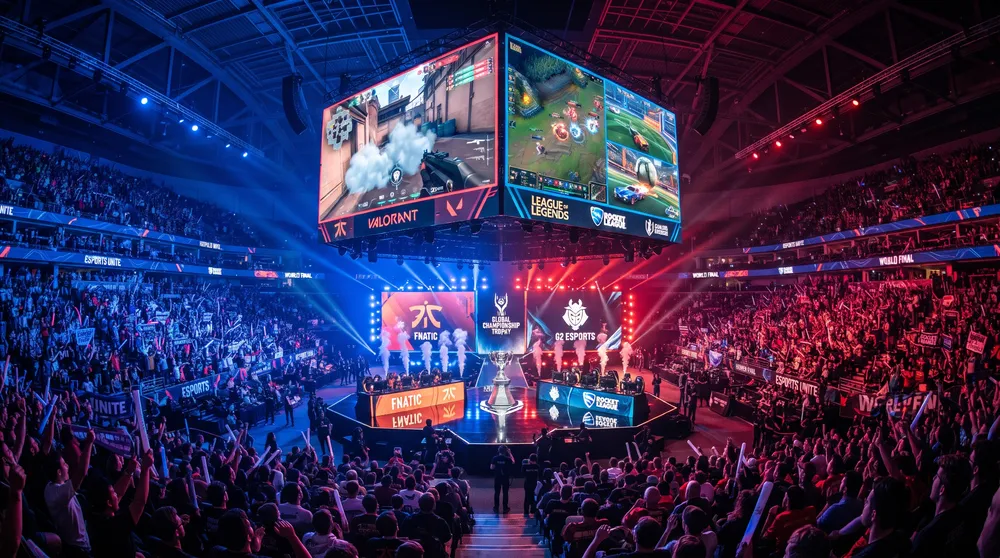
Not every popular multiplayer release succeeds as a competitive esport. Sustaining a global tournament circuit requires high mechanical skill ceilings, balanced spectator readability, deep strategic layers, and consistent developer support. Across international stadiums and online leagues, a core group of esports games anchors the professional industry.
Whether tracking national team rosters in our Esports Nations Cup 2026 schedule and featured games breakdown or comparing tactical gunplay in our top games like Valorant ranking, understanding the defining titles of competitive gaming reveals how modern circuits are built.
Here is an analytical breakdown of the premier titles leading competitive esports across major genres.
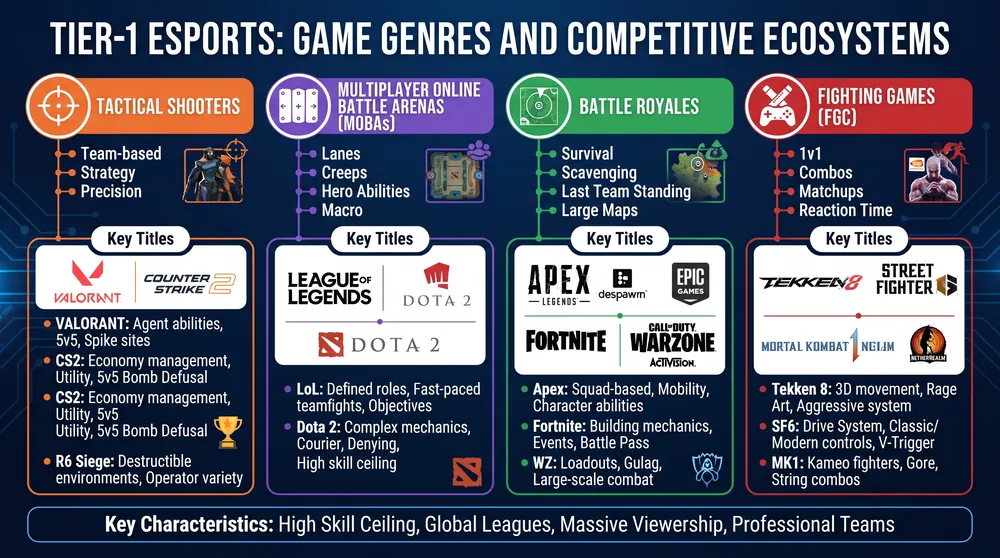
1. Tactical Shooters: Counter-Strike 2 and Valorant
Tactical first-person shooters remain the cornerstone of PC esports due to their low time-to-kill, round-based economy management, and tense clutch scenarios:
-
Counter-Strike 2 (Valve): The gold standard of pure mechanical gunplay. With no character classes or active abilities, every competitor relies on uniform utility (smokes, flashbangs, incendiary grenades), counter-strafing precision, and deterministic spray patterns. Its open Major circuit and massive skin economy sustain one of the longest-running ecosystems in gaming.
-
Valorant (Riot Games): Pairs classic 5v5 bomb-defusal gunplay with distinct Agent roles (Duelists, Initiators, Controllers, Sentinels). The Valorant Champions Tour (VCT) connects regional leagues across Americas, EMEA, Pacific, and China directly into international Masters and Champions LAN events.
2. Multiplayer Online Battle Arenas (MOBAs): League of Legends and Dota 2
MOBAs demand complex macro strategy, drafting foresight, and synchronized five-player execution:
-
League of Legends (Riot Games): The world’s most-watched esport, highlighted by the annual League of Legends World Championship (Worlds). Teams contest neutral objectives, manage minion wave states, and draft synergistic five-champion compositions across regional franchised leagues.
-
Dota 2 (Valve): Renowned for unmatched strategic complexity and massive crowdfunded prize pools at The International. With over 120 heroes unlocked from the start, high-ground terrain mechanics, item actives, and buyback economies, Dota 2 rewards deep drafting adaptability.
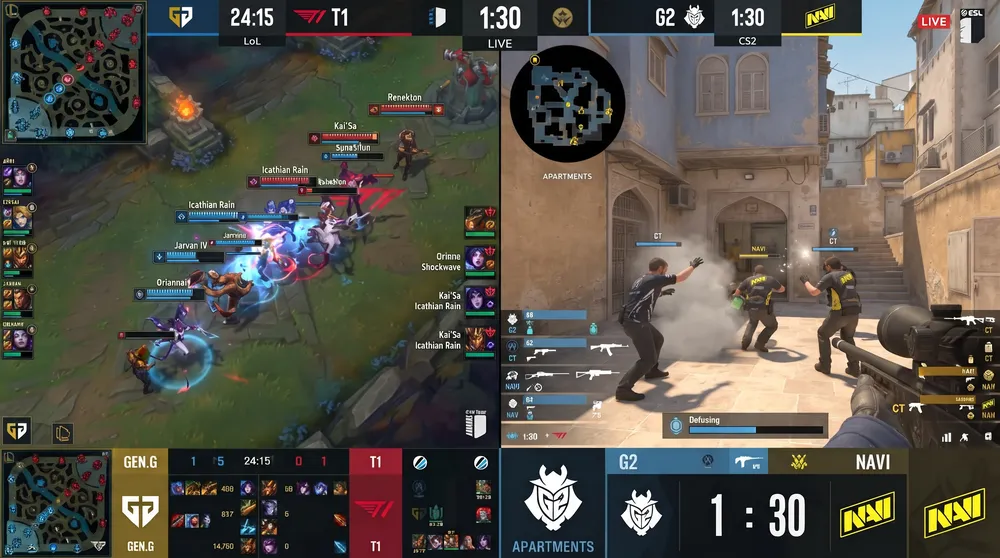
3. Battle Royales and Sports Simulations: Apex Legends and Rocket League
Beyond traditional 5v5 formats, physics-based sports and survival shooters command dedicated global audiences:
| Esport Title | Developer | Competitive Format | Core Skill Differentiator |
| Rocket League | Psyonix / Epic Games | 3v3 Vehicular Soccer | Pure 3D spatial physics, aerial car control, and zero RNG |
| Apex Legends | Respawn / EA | 20-Squad Battle Royale (Match Point) | High-speed movement tech, shield economy, and ring rotations |
| Fortnite | Epic Games | Duos / Trios Battle Royale (FNCS) | Rapid architectural building, piece control, and box-fighting |
| Street Fighter 6 / Tekken 8 | Capcom / Bandai Namco | 1v1 Fighting Game Community (FGC) | Frame-data mastery, reaction timing, and neutral spacing |
What Makes a Game Succeed as a Tier-1 Esport?
Publishers cannot manufacture a lasting competitive scene through prize money alone. Enduring esports titles share four structural traits:
-
Easy to Understand, Difficult to Master: Spectators can immediately grasp simple objectives (plant the spike, destroy the Nexus, score the goal) while pros execute micro-mechanics that take thousands of hours to refine.
-
Deterministic Competitive Integrity: Minimal random number generation (RNG) ensures match outcomes reflect player skill and team preparation rather than luck.
-
Developer Anti-Cheat and Server Infrastructure: High-tickrate servers and kernel-level anti-cheat protection keep ranked ladders viable as scouting grounds for emerging talent.


