
Esports Tournaments Explained: Single-Elimination, Double-Elimination, and Swiss Formats

Following competitive gaming requires understanding the architecture of competitive brackets. Unlike traditional sports that rely on straightforward regional schedules, game tournaments utilize mathematical bracket systems designed to minimize flukes, evaluate map depth, and ensure the two best squads meet in the grand final.
Whether tracking regional qualifiers or watching international stadium finals, recognizing bracket rules is essential for following tournament storylines.
Here is the complete primer on the three dominant tournament formats used across modern esports.

1. Single-Elimination: The High-Stakes Knockout
Single-elimination is the oldest and simplest format in competitive gaming:
-
The Rule: You win and advance, or you lose and you are instantly eliminated from the event.
-
Where It Is Used: League of Legends World Championship knockout stages, early open qualifiers, and select fighting game community (FGC) invitationals.
-
Strategic Strengths: Creates unmatched broadcast drama. Every single map carries life-or-death consequences, making Cinderella runs and shocking underdog upsets instantly memorable.
-
The Structural Flaw: High seeding sensitivity. If the two strongest teams in the world are seeded onto the same side of the bracket, they meet in the semifinals rather than the grand final, leaving the final match lopsided.
2. Double-Elimination: The Gold Standard for Tactical Parity
To eliminate seeding flaws and ensure that a single bad round does not end a team's tournament run, premier titles rely on double-elimination brackets:
-
Two Lives Architecture: Every qualified team starts in the Upper Bracket. If a team loses a series, they drop down into the Lower Bracket rather than being sent home.
-
The Lower Bracket Gauntlet: In the Lower Bracket, teams play with zero remaining lives. One more defeat results in permanent elimination. The team that survives the Lower Bracket advances to the Grand Final to face the undefeated Upper Bracket winner.
-
Upper Bracket Advantage: Because the Upper Bracket finalist has not lost a single match, tournament organizers award them a competitive advantage in the Grand Final, such as selection priority during map bans and picks or a dedicated map ban veto.
Double-elimination guarantees that tournament winners demonstrate resilience, deep tactical playbooks, and the ability to adapt to rival strategies over extended series.
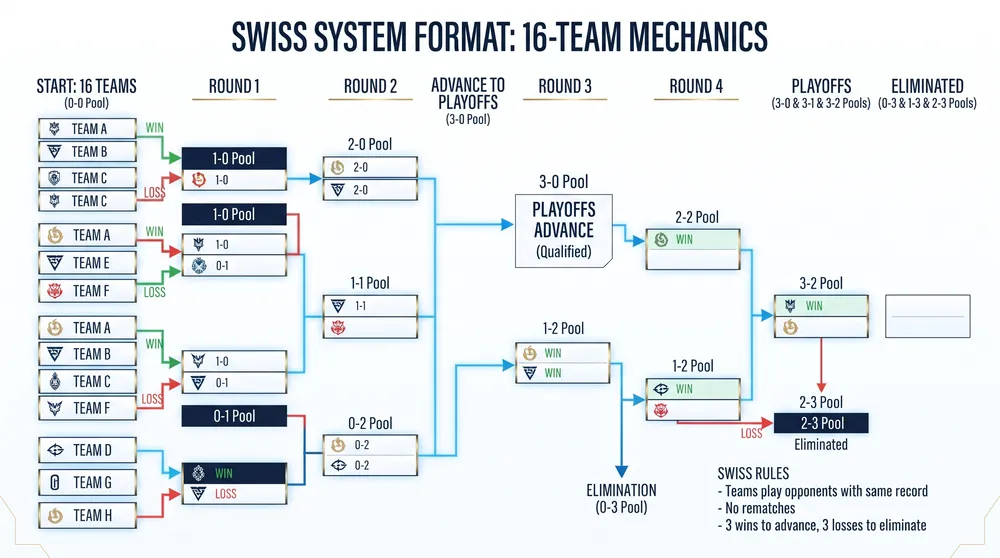
3. The Swiss System: Dynamic Skill-Based Pairing
Originally developed for chess tournaments, the Swiss System has become the premier group-stage format for massive international events like Counter-Strike Majors:
| Match Round | Pairing Logic | Qualification / Elimination Status |
| Round 1 | Initial seeds face off (all teams 0-0) | Neutral |
| Round 2 | 1-0 teams play 1-0 teams; 0-1 teams play 0-1 teams | Neutral |
| Round 3 | Teams paired strictly against identical records (2-0, 1-1, 0-2) | 2-0 teams play for direct advancement (3-0); 0-2 teams play for survival |
| Advancement Threshold | Win 3 Matches | Teams that secure 3 wins instantly advance to the playoff bracket. |
| Elimination Threshold | Lose 3 Matches | Teams that suffer 3 losses are immediately eliminated from the event. |
The Swiss System eliminates meaningless "dead rubber" matches where teams with zero chance of qualifying play out the schedule. Every single match features teams with identical records fighting for their tournament lives, delivering peak viewer engagement across every day of the group stage.


