
What Was Dynablocks? The Origin, Beta History, and Evolution of Roblox
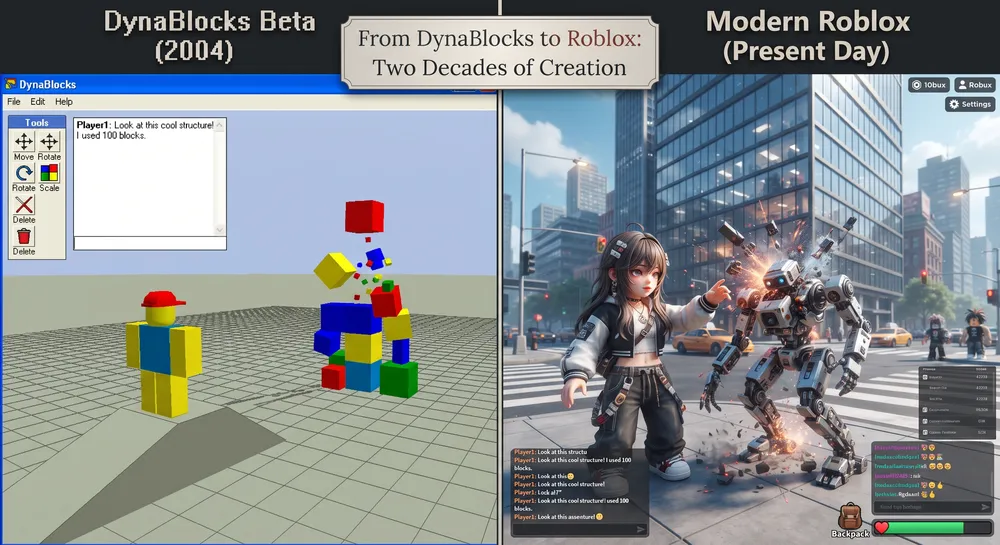
Long before Roblox became a multi-billion dollar platform hosting millions of concurrent players daily, it began as an experimental physics simulation called DynaBlocks. Search interest around the name continues to surge whenever community retrospectives, anniversary events, or classic archive builds resurface online.
For players who joined during recent years, the name sounds like a third-party clone or an emulator. In reality, DynaBlocks represents the foundational codebase and early corporate identity of Roblox itself.
Here is the factual history of DynaBlocks, how founders David Baszucki and Erik Cassel developed the system, and why the project was rebranded before its official public release.
The Origins of DynaBlocks: 2003 to 2004
The conceptual groundwork for DynaBlocks began in late 2003. Co-founders David Baszucki and Erik Cassel previously developed Interactive Physics, an educational 2D mechanics simulator used in academic classrooms. After selling their initial venture, Knowledge Revolution, the pair sought to replicate the joy of real-time engineering experiments inside a 3D digital sandbox.
-
December 12, 2003: Jim Stevens officially registered the domain name
dynablocks.comon behalf of the founding team. -
Early 2004 Development: The original software served as a local testing program where developers placed primitive geometric shapes to test structural integrity, gravity, and collision meshes.
-
The Physics Focus: Unlike modern experiences driven by high-speed racing or roleplay narratives, DynaBlocks focused almost entirely on physical simulation. Early demo levels challenged players to construct suspension bridges, stack weighted beams, and build working catapults without collapsing the structure under simulated stress.
During this prototype phase, the system ran with rudimentary rendering tools. Characters were modeled as rudimentary, blocky test figures, and network code was limited to local network connections.
Why the Name Changed from DynaBlocks to Roblox
Despite early progress under the DynaBlocks label, the identity was abandoned before the game reached wide public access.
By early 2004, the founders recognized several practical issues with the name:
-
Brand Recall and Pronunciation: Internal testing showed that users frequently misremembered or misspelled the name as "DinoBlocks" or "Dynamic Blocks."
-
Domain Challenges: The team wanted a distinct, memorable trademark that was easier for young audiences to spell and search.
-
The Merger of Concepts: In January and February 2004, the team coined the name Roblox, combining the words "Robots" and "Blocks" to reflect both interactive scripting logic and modular building blocks.
Following the decision, the official project files transitioned to the Roblox brand. The legacy domains, including dynablocks.com and dynablox.com, were retained by the company for years as direct URL redirects to the primary Roblox portal.
Key Features That Survived from DynaBlocks
While the original interface looked primitive compared to modern standards, several core architectural pillars created during the DynaBlocks era remain active inside the engine:
1. The Stud-Based Coordinate Grid
DynaBlocks established the fundamental unit of measurement known as the stud. Even with modern mesh imports, realistic lighting passes, and procedural materials, all object collision calculations, character movement speeds, and physics bounds are calculated using the original stud coordinate system established in 2004.
2. Physical Part Joining (Surface Types)
In the DynaBlocks prototype, objects adhered to one another through specific surface behaviors, such as Studs, Inlets, Welds, and Hinges. This allowed players to build complex articulated vehicles without writing custom code scripts. While modern developers rely heavily on Lua scripts and constraints, legacy surface properties remain accessible in Roblox Studio.
3. User-Generated Logic
The fundamental principle of DynaBlocks was that developers should provide the physical playground, while the community provides the content. That design philosophy survived untouched, forming the backbone of the platform's user-generated economy.
The Legacy of DynaBlocks in Modern Roblox
Today, references to DynaBlocks serve as iconic historical markers within platform lore.
-
Collector Badges and Rare Gear: Classic items, developer forum archives, and rare virtual assets reference the 2004 development cycle.
-
Archive Communities: Dedicated developer preservation groups continue to study early client builds to understand how basic physics calculations were handled before the introduction of cloud architecture.
-
Platform Milestones: During company anniversary events and investor retrospectives, official executive communications frequently highlight the original DynaBlocks concept files to illustrate how far the platform's visual fidelity and networking tools have advanced.
DynaBlocks was not a separate game, but the direct technological foundation that made modern Roblox possible. Understanding its history provides valuable perspective on how physics-first sandbox tools transformed into a global gaming network.


