Valorant Rank Distribution - Is Ranked Dead?

Rank distribution in Valorant is one of the clearest indicators of how a competitive ecosystem evolves over time.
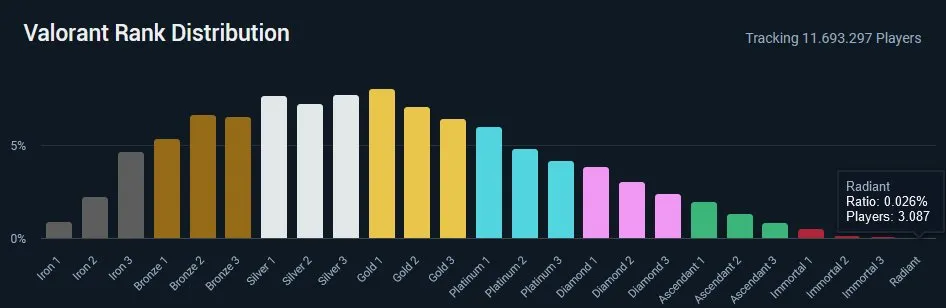
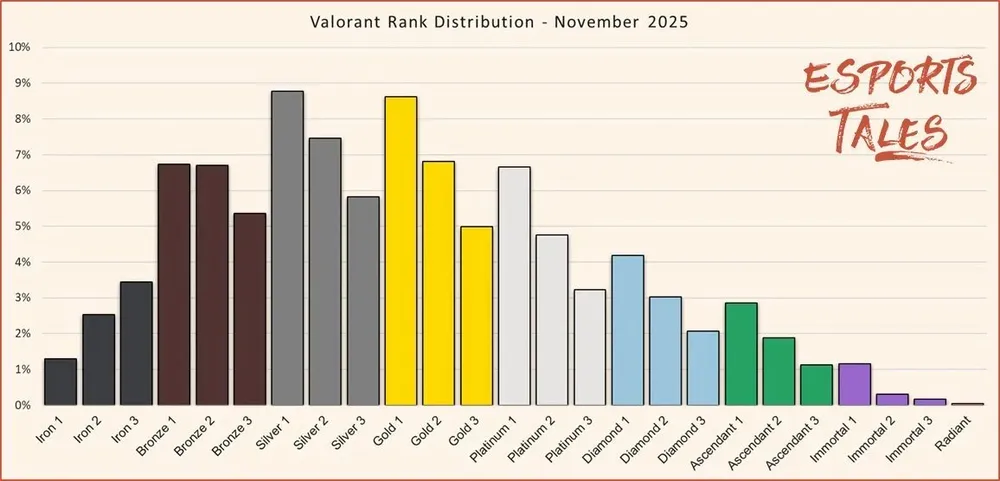
By comparing rank distribution data from 2024 (older chart with black background) and November 2025 (Esports Tales chart), we can evaluate whether players are genuinely improving, whether Riot’s ranking system has shifted, or whether population changes have altered the competitive landscape.
This article analyzes where players are concentrated, how higher ranks have changed, and what this means for rank advancement overall.
Overview of the 2024 Rank Distribution
The 2024 data shows a classic pyramid structure, heavily concentrated in the mid-tiers:
-
Silver and Gold dominate the population, forming the statistical “average” player.
-
Bronze still holds a large portion, especially Bronze 2–3.
-
Platinum marks the start of noticeable population drop-off.
-
Diamond and above become increasingly exclusive.
-
Radiant is extremely rare (≈0.03%), reinforcing its elite status.
This distribution reflects a tight MMR system, where advancement beyond Gold requires consistent performance and mechanical skill.
Overview of the 2025 Rank Distribution (November 2025)
The 2025 chart reveals several subtle but important changes:
-
Silver 1 and Gold 1 peak higher than in 2024, suggesting upward movement of the average player.
-
Bronze ranks shrink slightly, indicating fewer players stuck at the bottom.
-
Platinum and Diamond tiers grow, especially Diamond 1.
-
Ascendant is more populated and stable, no longer feeling like an extreme bottleneck.
-
Immortal remains exclusive, but slightly more accessible than before.
-
Radiant remains nearly unchanged, preserving its prestige.
The pyramid shape still exists, but it is less bottom-heavy and slightly taller at the top.
Key Comparisons and Trends
1. Upward Shift of the “Average” Player
In 2024, the statistical center leaned closer to Silver 2–3.
In 2025, it shifts toward Gold 1–2.
Interpretation:
-
Players are improving mechanically and strategically over time.
-
Knowledge once considered “high-elo fundamentals” (utility usage, economy management, map control) has become standard.
2. Reduced Bronze Population
Bronze tiers occupy a smaller percentage in 2025.
Possible reasons:
-
Better onboarding and tutorials
-
More educational content (YouTube, coaching culture)
-
Rank protection changes and smoother early-rank progression
This suggests that new players climb out of Bronze faster than before.
3. Platinum and Diamond Expansion
Platinum and Diamond show clear population growth, particularly Diamond 1.
This is significant because:
-
Diamond was once a hard ceiling for most players
-
In 2025, it functions more as a high-skill checkpoint rather than an endpoint
Implication:
Rank advancement beyond Gold is more achievable, but staying there still requires consistency.
4. Ascendant Stabilization
Ascendant, introduced to reduce Immortal crowding, appears healthier and more evenly distributed in 2025.
-
Less compression
-
Clearer separation between Diamond and Immortal
-
More players can experience “high elo” without breaking competitive integrity
This is a sign of successful rank system tuning.
5. Elite Ranks Remain Exclusive
Despite overall upward movement:
-
Immortal and Radiant percentages remain very low
-
Radiant’s population is almost unchanged
This confirms that:
-
Riot preserved top-tier exclusivity
-
Rank inflation has not devalued elite achievement
Conclusion: Is Rank Advancement Easier in 2025?
Short answer: Yes, but really only up to a point.
What has improved:
-
Faster early progression (Iron → Gold)
-
Higher average player skill
-
More players reaching Platinum and Diamond
What has not changed:
-
Immortal and Radiant are still brutally competitive
-
Skill gaps at the top remain massive
-
Rank still reflects genuine performance, not just playtime